Australia 2026 Solar & Battery Rebate Guide: How to Beat 4c/kWh Feed-In Tariffs
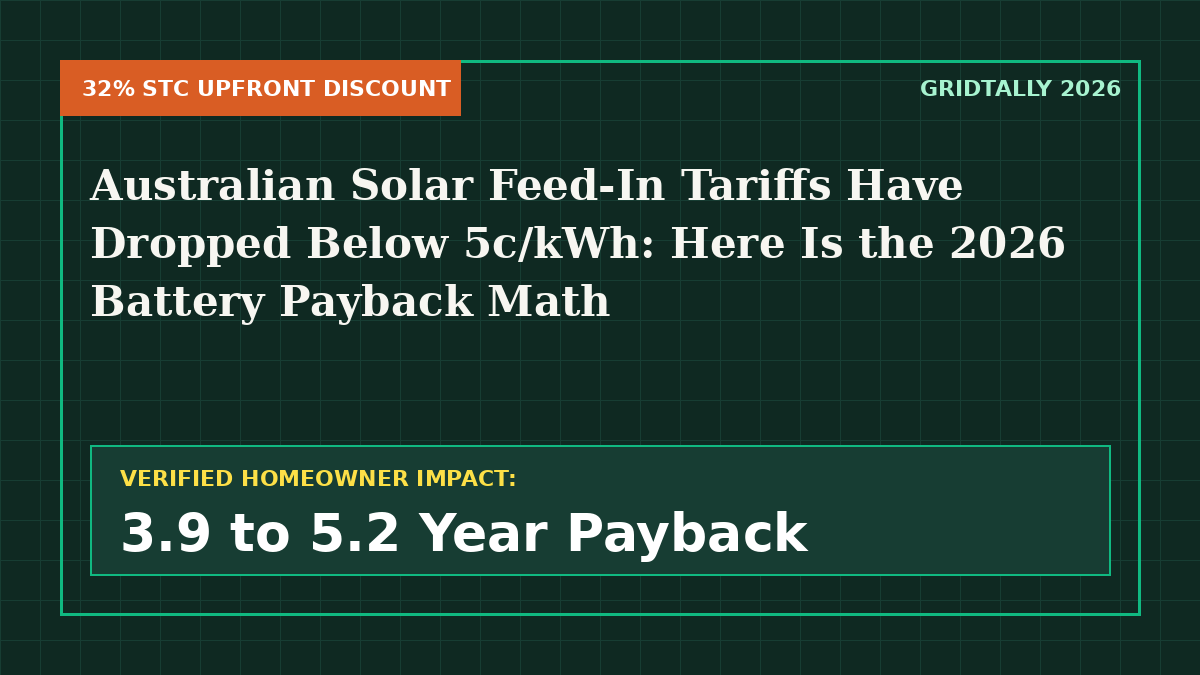
As daytime solar feed-in tariffs drop to 3.5c–6c/kWh across NSW, Victoria, Queensland, and SA, right-sizing 6.6 kW to 10 kW arrays with federal STCs and state battery incentives cuts payback under 4.8 years.
Key 2026 Engineering Findings for Homeowners
- ✓Across the National Electricity Market (NEM), daytime minimum feed-in tariffs (FiTs) now sit between 3.3c and 6.2c/kWh while evening peak retail tariffs exceed 38c to 54c/kWh.
- ✓Australia still enjoys the lowest installed residential solar hardware cost in the OECD (~A$0.95 to A$1.20/Watt after upfront Federal Small-scale Technology Certificates).
- ✓Shifting hot-water resistive tanks, pool filtration pumps, and EV charging to a 10:00 AM–3:00 PM timer ('Solar Soaking') boosts self-consumption from 28% to 68% without extra hardware.
Run Your Exact Household Tariff & Load Numbers
Model US ($), UK (£), Canada (C$), and Australia (A$) tariffs and 10-year cumulative payback with zero signup.
Why Australia's 6.6 kW & 10 kW Solar Math Changed in 2026
Over 3.9 million Australian rooftops now host solar photovoltaic systems—the highest per-capita penetration on Earth. Because rooftop solar supplies more than 50% of daytime grid demand across South Australia, Victoria, and Queensland on sunny spring afternoons, energy retailers regulated by the Australian Energy Regulator (AER) and Victoria's Essential Services Commission have reduced flat daytime Feed-in Tariffs (FiTs) to 3.3c–6.0c per kWh, with some distributors introducing "two-way solar export tariffs" during midday congestion.
Despite low export credits, upfront installation costs in Australia remain extraordinarily low thanks to the federal Small-scale Renewable Energy Scheme (SRES / STCs), which provides a ~28% to 32% point-of-sale discount on Clean Energy Council (CEC) approved panels and inverters.
2026 Australian State-by-State Solar & Battery Payback Benchmarks
| State / Network | Avg Peak Retail | Typical Daytime FiT | 6.6 kW Net Installed Cost | Payback (55% Self-Use) |
|---|---|---|---|---|
| NSW (Ausgrid / Endeavour) | A$0.36 – A$0.48/kWh | 4.9c – 6.5c/kWh | A$5,600 – A$6,900 | 3.6 – 4.4 Years |
| Victoria (Solar Homes Rebate) | A$0.31 – A$0.41/kWh | 3.3c – 5.2c/kWh | A$4,400 – A$5,800 (after A$1,400 rebate) | 3.4 – 4.2 Years |
| Queensland (Energex / Ergon) | A$0.32 – A$0.43/kWh | 5.0c – 7.5c/kWh | A$5,400 – A$6,700 | 3.3 – 4.1 Years |
| South Australia (SA Power) | A$0.44 – A$0.56/kWh | 4.0c – 6.5c/kWh | A$5,800 – A$7,100 | 2.9 – 3.7 Years |
The "Thermal Battery" Trick: Daytime Hot Water & Split-System Pre-Cooling
Before spending A$9,500 on a 10 kWh lithium battery, Australian homeowners can capture 40% of a battery's financial benefit for under A$250 by installing a DIN-rail Wi-Fi contactor on their electric storage hot-water cylinder or heat-pump hot water unit. Heating 315 litres of water between 11:00 AM and 2:00 PM absorbs 8 to 11 kWh of free rooftop solar every day—saving A$1,100+/year compared to heating water on peak or controlled-load tariffs.
Worked Math: Daytime Solar Curtailment vs. Evening Tariff Arbitrage in Australia
Across Ausgrid (NSW), CitiPower/Powercor (VIC), Energex (QLD), and SA Power Networks, midday solar feed-in tariffs have fallen to roughly A$0.03–A$0.07/kWh while evening peak time-of-use rates between 4:00 PM and 9:00 PM often reach A$0.38–A$0.52/kWh (check your local retailer plan under the Australian Energy Regulator Default Market Offer).
Worked Example — 10 kWh LFP Battery Daily Arbitrage Value: If a 6.6 kW rooftop array exports 11 kWh of excess midday solar at a A$0.05/kWh feed-in tariff, that export earns only 11 × A$0.05 = A$0.55/day. Storing that same 11 kWh inside a 10 kWh usable Lithium Iron Phosphate (LFP) battery at 90% round-trip efficiency delivers 9.9 kWh during the evening peak window at A$0.42/kWh, worth A$4.16/day—an extra A$3.61 per sunny day (or roughly A$1,150+ per year across 320 cycling days) in bill reduction.
How Federal STCs & Three-Phase Export Limits Work Across Australian DNSPs
When sizing a rooftop solar and battery system in Australia, two technical factors beyond your quarterly electricity bill determine your optimal array size (always check the Clean Energy Regulator and your local Distribution Network Service Provider rules):
- Federal Small-scale Technology Certificates (STCs) Deeming Period: Under the Federal Small-scale Renewable Energy Scheme (SRES), the upfront STC point-of-sale discount is calculated from your postcode's solar zone rating multiplied by the remaining years until the scheme ends in 2030. In 2026, a 5-year deeming period applies (down from 6 years in 2025), reducing the upfront STC discount by roughly A$450–A$600 on a 6.6 kW system each calendar year you wait.
- Single-Phase 5 kW vs. Dynamic Export Limits: Most Australian single-phase connections have a 5 kW AC static export limit (paired with 6.6 kW of DC panels under the 1.33× inverter rule), while South Australia Power Networks, Energex, and Ausgrid increasingly support flexible/dynamic export limits up to 10 kW per phase for compliant smart inverters. Adding a DC-coupled hybrid LFP battery lets you install 8 kW to 10 kW of rooftop panels even on a 5 kW export-limited single-phase meter because excess midday DC power flows straight into the battery without crossing the AC export limit.